
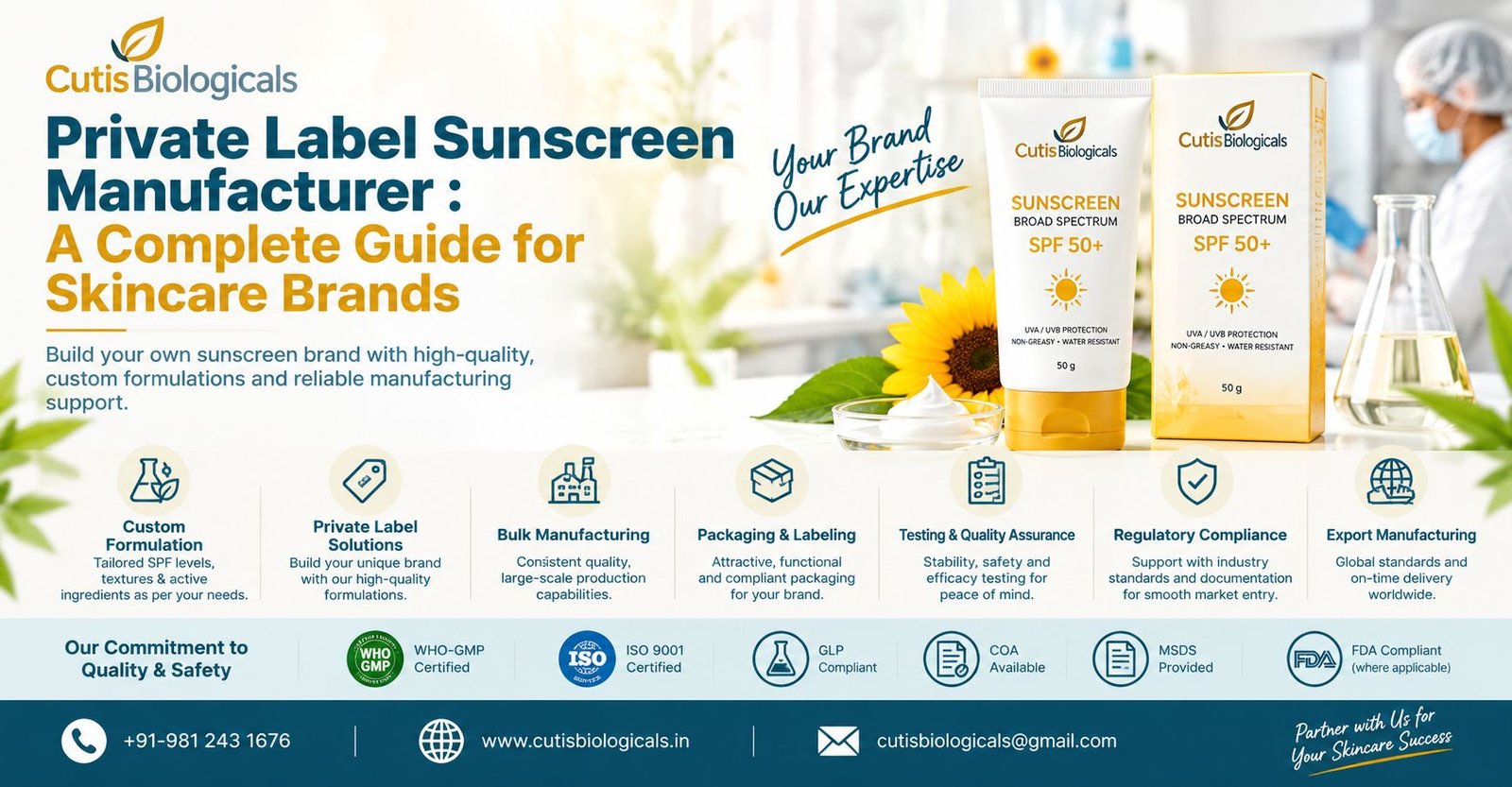
Sunscreen is one of the few skincare products people use every day, and demand keeps growing.
If you want to launch your own range, a private label sunscreen manufacturer can make the product while you build the brand. You skip the factory, the lab and the plant licensing.
This guide explains how the process works, what to ask before you sign and what affects your costs. It’s written for skincare brands, founders and clinics in India who want a clear path from idea to shelf.
What is a Private Label Sunscreen Manufacturer?
This type of manufacturer makes sunscreen in its own facility and sells it under your brand name. Your name goes on the tube. The manufacturer handles formulation, production, testing and filling. You handle branding, marketing and sales.
Brands usually pick one of two routes. The first is a ready formula, where you choose a tested base and add your label. The second is a custom formula, where chemists build a new product to your brief. A private label sunscreen manufacturing company brings the plant, the chemists and the quality systems. You bring the vision.
Why Should Skincare Brands Choose Private Label Sunscreen Manufacturing?
Building a plant costs a lot and takes years. Private label manufacturing lets you start with a small batch and grow as sales grow.
You also get formulation skills you may not have in-house. A good sunscreen needs stable filters, a pleasant feel and reliable SPF results. An experienced sunscreen cream manufacturer meets all these needs efficiently.
Speed is another gain. With a ready formula, you can reach samples much faster than you could by developing a product from scratch. Risk stays low, too, because you order batches you can sell. That leaves your time free for what builds a brand: your story, your customers and your marketing.
What Types of Sunscreen Products Can You Launch?
Your range should match your customers. Here are the main options.
SPF 30 and SPF 50 Sunscreens
SPF 30 blocks about 97% of UVB rays, and SPF 50 blocks about 98%. The gap looks small, but SPF 50 suits people who spend long hours outdoors or have fair or sensitive skin. Many brands launch both, so shoppers can choose by daily need.
Broad-Spectrum Sunscreens
Broad-spectrum products protect against UVB, which burns skin, and UVA, which drives ageing and pigmentation. Shoppers now look for this label first. Make it standard across your range.
Mineral and Chemical Sunscreens
Mineral sunscreens use zinc oxide or titanium dioxide to reflect and scatter UV. Chemical sunscreens use filters that absorb UV and turn it into small amounts of heat. Mineral options suit sensitive skin and children. Chemical ones feel lighter and leave less white cast. Some formulas combine both.
Sunscreen Gels, Creams, and Lotions
Gels suit oily and acne-prone skin. Creams suit dry skin and colder months. Lotions sit in between and spread easily over large areas of the body. Pick the texture that fits the skin type you want to serve. A sunscreen cream manufacturer will usually offer all three, so ask for samples of each.
Tinted Sunscreens
Tinted sunscreens add a light shade that evens out skin tone. They also help mineral formulas blend in without a white cast. Shade matching matters here, so ask how many tones the manufacturer can offer for Indian skin.
Water-Resistant Sunscreens
Water-resistant sunscreens stay on through sweat and swimming. They suit sports, beach holidays and humid cities. These claims need proper testing, so ask to see the results before you print them on a label.
How Does a Private Label Sunscreen Manufacturing Company Work?
Step 1: Choose Your Sunscreen Product
Start with one clear product and one clear customer. A daily face sunscreen for oily skin is a better start than five products for everyone. Also, consider skin type, texture, SPF and price range.
Step 2: Select the SPF Level and Formulation
What will the SPF level be? Do you want the formula to be mineral, chemical or hybrid?
Step 3: Finalise Ingredients and Product Specifications
Consult with the manufacturer’s R&D team to choose secondary active ingredients such as antioxidants, soothing botanicals and moisturisers. Consider scent, finish (matte vs. dewy) and packaging styles.
Step 4: Test Product Quality, Stability, and Sun Protection
How will your product hold up in heat and time? This is where asking for stability tests is important. A good private label sunscreen manufacturer will provide you with reports of each test.
Step 5: Design Labels and Packaging
It is important to choose your packaging. Whether it is a bottle or a pump, the right packaging protects your sunscreen formulation. Also, check if the labels mention the SPF, broad-spectrum claim, ingredients, dates, batch number, and date.
Step 6: Approve Samples and Place Your Order
Try the samples on real skin and judge the feel, finish and scent. Collect feedback from staff and a few dermatologists. Approve only when you’re happy, then confirm quantity, price, payment terms and delivery date in a written order.
Step 7: Begin Production and Product Delivery
Once the product passes all tests and goes through packaging, it is delivered to you.
How to Choose the Right Private Label Sunscreen Manufacturers in India?
Many brands pick on price alone and regret it later. Run through these seven checks instead.
Check Manufacturing Licenses and Certifications
Ask for the manufacturing licence from the state licensing authority and proof of GMP compliance. ISO 22716 is a recognised standard for cosmetic GMP. Certificates should be current and show the facility’s name and address.
Review Product Quality and Testing Standards
A reliable manufacturer tests raw materials, in-process samples and finished batches. Ask who does the SPF testing, which method they use and whether you’ll receive the reports.
Evaluate Formulation and Customisation Options
Check how much freedom you get. Can you change the SPF, texture, fragrance or filters? A good partner has in-house chemists who can adjust a formula and explain the trade-offs.
Ask About Minimum Order Quantities
Minimum order quantities differ widely. Lower quantities let you test the market with less stock. Higher ones often bring a lower cost per unit.
Compare Pricing and Production Timelines
Look at unit costs, bulk discounts, payment terms and average turnaround times from sample approval to final delivery.
What Ingredients to Include in Your Sunscreen Formulation?
Mineral UV Filters Such as Zinc Oxide and Titanium Dioxide
Zinc oxide is known for protecting from both UVA and UVB. Titanium dioxide is another ingredient that does the same job. Both are ideal for sensitive skin. Most brands offer the combination of both.
Chemical UV Filters
Avobenzone, octocrylene and newer filters such as Tinosorb S are common examples. They absorb UV and feel light on the skin. Some people react to certain filters, so ask which ones the manufacturer uses and why.
Moisturising Ingredients Such as Glycerin and Hyaluronic Acid
Glycerin draws water into the skin, and hyaluronic acid helps hold it there. Together, they stop a sunscreen from feeling dry or tight. That matters, because people skip products that feel heavy.
Skin-Soothing Ingredients Such as Aloe Vera
Aloe vera calms redness and adds a cooling feel. Allantoin and panthenol work in a similar way. These ingredients suit sensitive-skin and after-sun variants.
Ingredients for Different Skin Types
Oily skin does well with gels and light, non-comedogenic bases. Dry skin needs creams with ceramides or shea butter. Acne-prone skin may benefit from niacinamide.
How Much Does Private Label Sunscreen Contract Manufacturing Cost?
There’s no single price. Cost depends on the choices below, so ask every manufacturer for a written quote based on the same brief.
Type of Sunscreen and Formulation
Gels often need simpler processing than tinted creams or water-resistant lotions. The more complex the texture and the longer the stability work, the higher the cost per unit.
SPF Level and Active Ingredients
Higher SPF needs more or better filters, and filters are costly. Newer, more stable filters usually cost more than older ones. Mineral blends need special processing to stay smooth.
Minimum Order Quantity
Bigger batches spread fixed costs across more units, so the price per piece falls. Smaller batches cost more per unit but reduce your stock risk.
Packaging and Label Design
Tubes, pumps, cartons and printing can take a large share of your budget. Custom designs cost more than stock packaging. Plan this early.
Testing, Certification, and Compliance Costs
SPF tests, stability studies, microbial checks and paperwork all carry fees. Some are one-time, while others repeat with each new formula. Ask which ones your quote includes.
Customisation and Production Volume
A fully custom formula costs more than a ready base. Regular, higher-volume orders are less expensive. Ask the private label sunscreen suppliers whether prices improve once you reach set volumes.
Launch Your Sunscreen Brand with Cutis Biologicals
Cutis Biologicals is a dermatology-focused company based in Ambala Cantt, Haryana. Our range covers sun protection, skin care, hair care and baby care, and its website states that it follows GMP and WHO norms with quality control across its skincare products. The company also invites distributors, MRs and pharma professionals to partner with it across India.
If you’re looking for a private label sunscreen manufacturer, speak to the Cutis Biologicals team about your product brief, SPF target, packaging and order size. To learn more, call +91-981 243 1676.
Conclusion: Working with a Sunscreen Cream Manufacturer Saves Money and Time
Private label manufacturing gives skincare brands a faster, lower-risk way to launch sunscreen. You avoid plant costs while leveraging ready expertise. It lets you focus on making your products better instead of going through the hassles.
However, it is important to get familiar with the process.
Partnering with a leading private label sunscreen manufacturer guarantees your products are formulated to the highest standards of quality, stability and regulatory compliance.
Compare manufacturers on what your product needs, what your budget allows and where you want the brand to be in three years. Ask for documents, test reports and samples before you commit. A good partner will welcome those questions.
Frequently Asked Questions
What is private label sunscreen manufacturing?
It’s an arrangement where a manufacturer produces sunscreen, and you sell it under your own brand. The manufacturer handles formulation, testing, production and filling. You handle branding, marketing and sales.
Can I launch my own sunscreen brand without a manufacturing facility?
Yes, you can. In fact, most new brands choose this route to launch their products. You hire a manufacturer for production. You still need your own business registration, such as GST, and labels that meet legal requirements.
What is the minimum order quantity for private label sunscreen?
It varies by manufacturer, formula and packaging. Ready formulas usually have lower minimums than custom ones. Ask for the exact figure in your quote.
Can I customise the SPF level and sunscreen formulation?
Yes, through custom formulation. The manufacturer adjusts the filters, base and texture to your brief. Any change needs fresh testing to confirm the SPF.
How long does it take to manufacture private label sunscreen?
It depends on whether you choose a ready or custom formula. Ready formulas move faster. Custom products need time for sampling, stability tests and SPF testing. Ask for a written timeline before you order.
Is SPF 50 sunscreen better for my skincare brand than SPF 30?
SPF 50 blocks about 98% of UVB and SPF 30 about 97%. SPF 50 suits long outdoor exposure. SPF 30 works for everyday use. Many brands offer both and let customers choose.
How can I find a reliable private label sunscreen manufacturer in India?
Check licences, ask for test reports and request samples. Speak to current clients and visit the plant if you can. Compare at least three written quotes before you decide.
Does my sunscreen need to be broad-spectrum?
Yes, if you want to compete. Shoppers expect protection against both UVA and UVB. Broad-spectrum claims should be backed by test results.
Do I need to test the SPF of my sunscreen?
Yes. Test results support the SPF on your label and protect you from false-claim problems. Ask the manufacturer which lab and method it uses.
Can I order samples before placing a bulk order?
Yes. Always approve samples first. Check the feel, scent, finish and packaging before you confirm the order.
What packaging options are available for sunscreen?
Common choices include tubes, bottles, pump dispensers and cartons. Tubes suit travel sizes, and pumps suit lotions. Pick packaging that protects the formula from light and air.
Can I launch a sunscreen for children?
Yes. Many brands use mineral filters and gentle, fragrance-free bases for children. These products need careful safety checks and honest claims.
Who owns the formula in private label manufacturing?
It depends on your agreement. Ready formulas usually stay with the manufacturer. Custom formulas can be exclusive to you if the contract says so. Always get this in writing.
What documents do I need to start a sunscreen brand?
You usually need a business registration, a GST number and clear label details. A trademark is also worth considering. Confirm the full list with your manufacturer.
Should I register a trademark for my sunscreen brand?
It’s a smart step. A trademark protects your brand name and logo from copying. Check availability before you print any packaging.
Can I visit the manufacturing facility before I sign?
Most reliable manufacturers welcome visits. A visit lets you see hygiene standards, equipment and quality checks first-hand. Ask for a visit early in the process.
How do I price my private label sunscreen?
Start with your cost per unit, including packaging, testing and shipping. Add your marketing costs and your margin. Then compare the result with similar products in your market.