
India’s skincare industry is growing rapidly. There’s praise on social media, as a number of top brands or personalities run campaigns about how to take care of yourself or how to become more self-aware. No one can invest money in this industry unless they know every detail about it. Additionally, it is no easy task to select a trusted skincare manufacturing company. This insight will help you to pick the most reputable skin care manufacturer in India.
Opt For The Best Skincare Manufacturing Company With These Tips
Congratulations, you are now getting into the most important section of the blog. In this section, you will come to know about the meticulously framed unit of a skin care manufacturing company in India. It is a great guide for new investors and investors with a business-to-business orientation who want to find a sector in which they can appreciate their investment for a higher ROI.
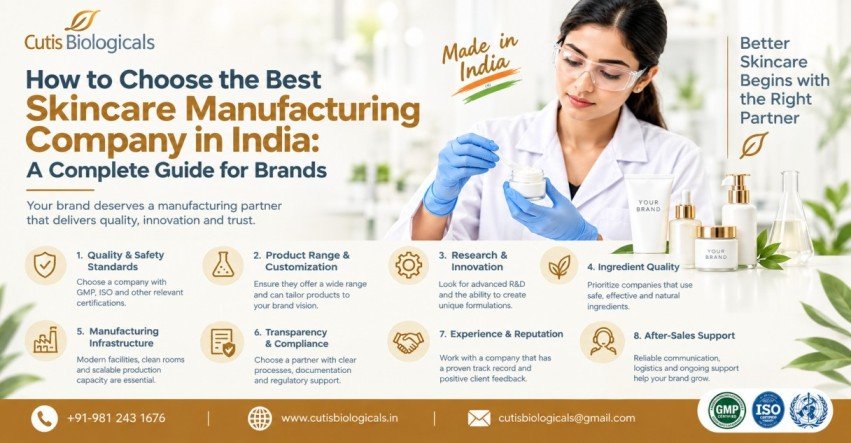
Selection of a skincare manufacturing company in India requires you to keep on the following 5 tips.
1. Financial Forensic Filter
The crucial part is to check the debt ratio on the manufacturer’s assets. When the debt ratio is high, the manufacturer will supply the other material to meet your production needs. This will impact the quality of the final product. The best choice is to investigate the manufacturer’s payment process for chemical suppliers. The credit issues will make an impact if not paying their suppliers on time, as there will be a problem within the supply chain. Moreover, you must ensure that the skin care manufacturer in India is keeping track of and following the yield loss sheet. If the manufacturing is not able to maintain the wastage at 2% to 3%, then it means something is “fishy” with their machinery.
2. The Floor Level Statistics
Are you still trusting ISO certificates that are pasted on the walls? Now it’s time to break out of your rut and accept realities. In addition to the adequate certificate, there are some things that you need to take a look at that work on the ground. Request the Overall Equipment Effectiveness (OEE). If the derma skin care manufacturer is unable to maintain OEE above 75%, then the machinery is not reliable. Request the logs of downtime from last quarter and check the OEE percentage.
3. Ingredients Protocol
If the COA (certificate of analysis) is given to you by the manufacturer, then it is their responsibility to present a valid COA explaining that the product was tested independently by another laboratory. It is urging the skin care manufacturing company in India to submit a sample of any product which they make and go to the authentic private lab. Have the product tested; produce a clearance certificate. This will make sure that their COA certificate will have some weight in it and fall into the recognized category.
4. Labor Cost-Effective
The ratio of labour (staff on floor) to other sections is not up to 20% for final evaluation of tribal knowledge of the machinery. In such a situation, the full potential of the machinery is never realised. In this way search for backup generator support for skin care manufacturing units in India.
5. The Point Safe Approach
The “formulation ownership” is the most important unresolved policy issue at the time of the exit framework. All other guides talk about going into business, but none of the guides discuss at any length what to do on the exit and its legalities. This section is a must-read. The responsibilities for the white-label and custom formulation ownership have to be identified by asking the manufacturer at exit and inquiring about the ownership of the formulation. The next thing you need to clarify is to sign the non-compete agreement. In the majority of cases, a single derma skin care manufacturer processes orders of variations of the product from various markets and, without the buyer’s awareness, just sells the same formula to several companies, in order to save time and development costs.
Which Questions Every Brand Should Ask To Align All Its Activities With Its Goals ?
Now that you’ve narrowed down your list of alternative private label skincare manufacturers and custom partners, here are those practical questions to ask in the initial meeting(s):
- What is the minimum order quantity you take for this product kind? (The most critical factor for a new brand’s budget).
- Is it possible to give a comprehensive itemised cost breakdown or Cost of Goods Sold (COGS) for a first production batch?
- When you place the next order versus an order for a custom-made end-of-the-week formulation, what is the difference in the time required to get them to your warehouse?
- Do you have case studies or references from other skin care brands you’ve been involved with?
- Where do you perform verification tests (such as Stability tests), and what tests are included in the formula fee?
- Are you certified for GMP, and can you provide proof of this certification?
- How do you propose new ideas, and how is a plan for the development of a new custom product created?
- What is your average R&D cycle time for custom product development?
- Who will I have to work with on a day-to-day basis as my main point of contact for the project?
Conclusion:
This blog highlights the selection of a good skincare manufacturing company that provides a good and reliable skincare product. It has been carefully written after a lot of R&D efforts and in collaboration with industry experts. Scan all of the information classes, and think about what kind of manufacturer you’d like to partner up with. If you have any questions or are looking to learn more details when starting a skincare business, give the experts at Cutis Biologicals a call.